
Property selling taxes
There are several taxes to be paid on the sale of a property, two are payable once the property is sold and another can be negotiated with the buyer:
- The municipal capital gain or Tax on the Increase in Value of Urban Land (Plusvalía Municipal)
It is a tax that must be paid within the following 30 working days from the day of the sale before a notary. It is a tax of municipal character and therefore it will vary depending on the municipality where the property is located.
- Personal Income Tax (Impuesto sobre la renta de las personas físicas, IRPF).
It is a personal and direct tax that taxes the income of individuals according to their nature and their personal and family circumstances. In the case of the sale of a property, it taxes the increase in capital of the seller. It is a tax that is paid the year after the sale, since the tax declaration reflects what was earned the previous year.
Non-residents in Spain must pay the tax through form 210 regarding the Income Tax of Non-Residents. By means of form 210, the income, yields, patrimonial gains, income from real estate (rental income) are declared. This includes the gain from the sale of real estate.
- Real estate tax (Impuesto sobre bienes inmuebles, IBI).
It is paid by all the owners of real estate (apartments, parking lots, storage rooms, locals, etc.), also by the usufructuaries, among others.
Regarding who must pay it, the one who is the owner on January 1 of that year must pay it, since the totality of the tax is paid in advance.
This means that, even if the owner changes, the tax will have already been paid.
BECOME A CLIENT
Get your first informative appointment, free of charge!
Tax on the Increase in Value of Urban Land
The Municipal Capital Gains Tax (Plusvalía Municipal) is a tax on the increase in the value of urban land at the time it is transferred. As its name indicates, the tax is levied on the increase in value that the property has experienced during the time that it has been owned. It is a tax that is in charge of the town halls, so it can vary. It is generally paid by the seller, if the property is received by inheritance or donation, then the tax is paid by the new owner.
In the case of buying a property from a non-resident in Spain, there is a danger that, if they do not pay the capital gain, the substitute for payment will be the new owner. For this reason, it is usually agreed that the seller sets aside an amount equivalent to the capital gain at the time of purchase, to ensure payment.
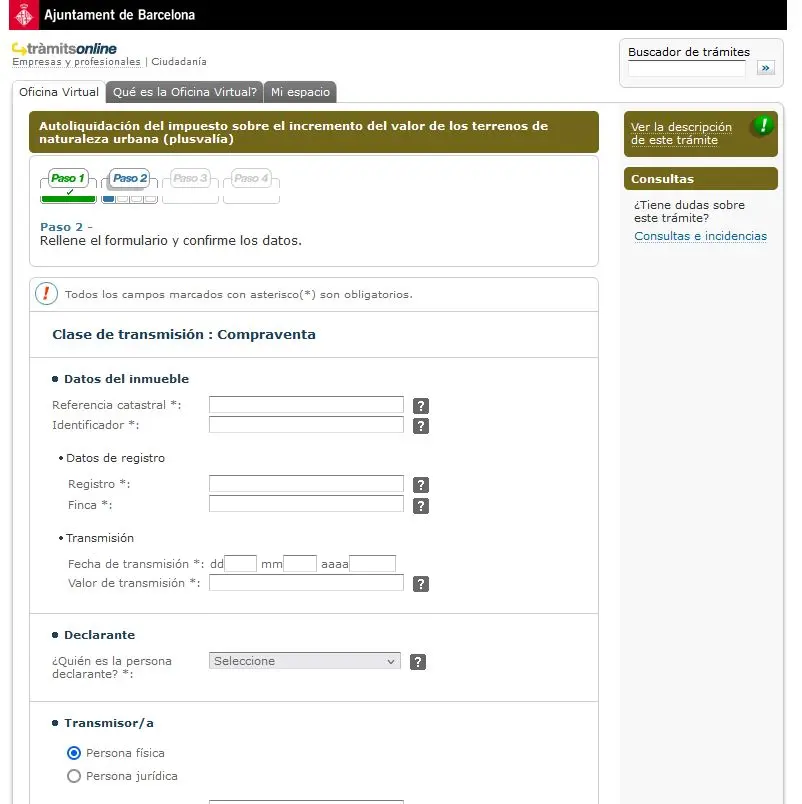
Currently, there are two ways of calculating the total amount:
- Objective method: the cadastral value of the land is multiplied by the legal coefficient depending on the period of time elapsed between the acquisition and the transfer.
- Method of calculation of the real increase (direct estimation) will be applied at the request of the interested party: the percentage corresponding to the cadastral value of the land at the time of the transfer is applied to the acquisition and transfer values and then the difference of the values obtained is made.
If there has not been an increase in value, the tax is not to be paid. In any case, you will have to go through the payment procedure before the tax office.
The tax must be paid during the first 30 working days after the sale before a notary.
If the transfer is for an inheritance, the term is 6 months extendable to one year.
Personal Income Tax
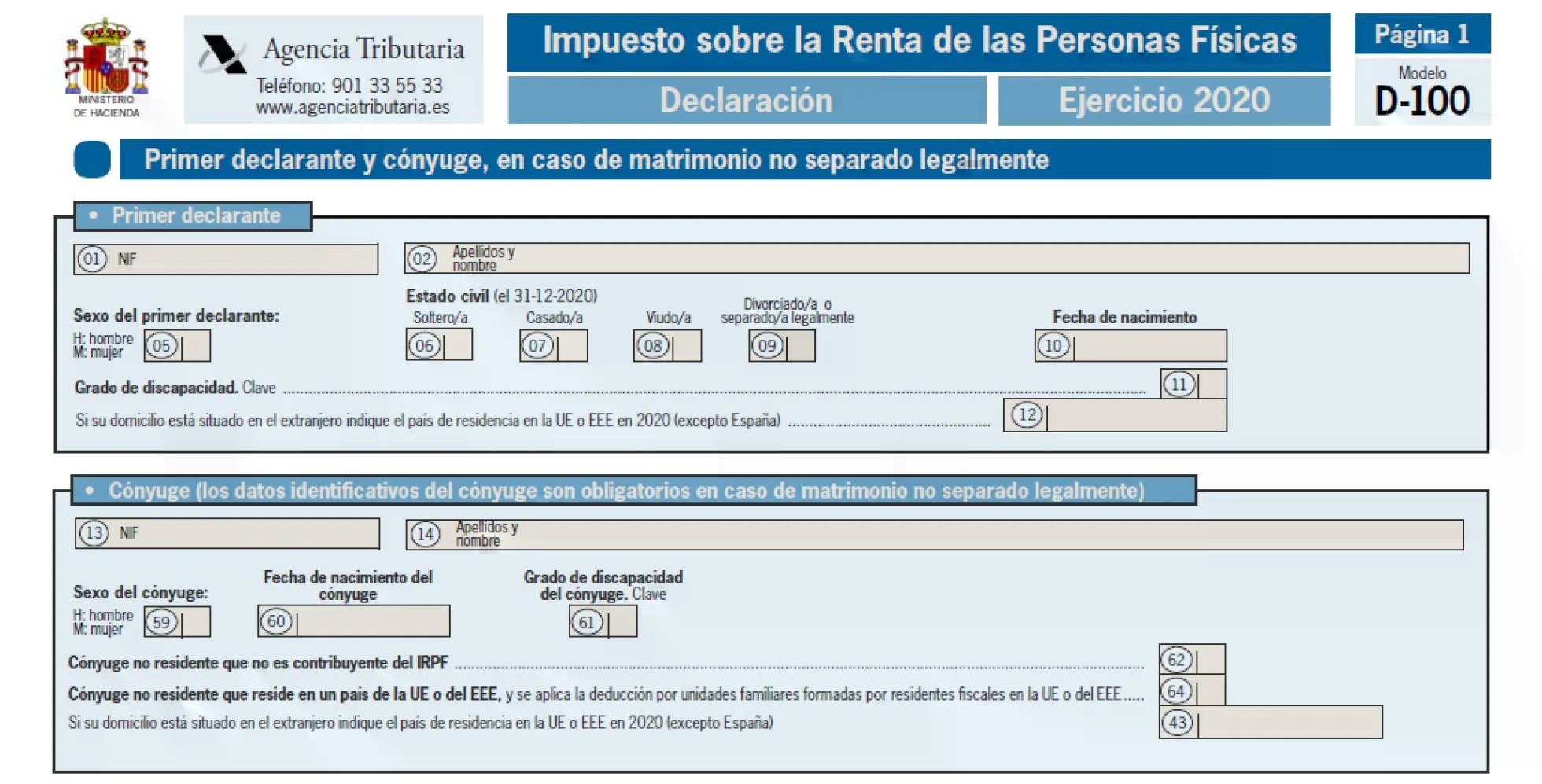
The Personal Income Tax (IRPF) is a personal and direct tax that taxes the income of individuals according to their nature and their personal and family circumstances. In the case of the sale of a property, it taxes the capital gain of the vendor. It is a tax that is paid the year after the sale, since the tax declaration reflects what was earned the previous year. In some cases, the gain may be exempt:
- If a reinvestment is made in a primary residence.
- If the sale of a primary residence is made by a person over 65 years of age.
- If the sale of the home is made by a person over 65 and the profit is destined to a lifetime rent.
- In the cases of dation in payment (Dación en pago).
In order to know the capital gain, the acquisition value must be subtracted from the transfer value.
On the one hand, the transfer value is calculated, which is the net amount that remains to the seller. To know the net amount or value of transmission it is necessary to subtract to the amount of sale, the expenses and taxes of the operation.
On the other hand, the acquisition value is calculated, that is to say, the amount paid by the seller at the time. To this amount it is necessary to add the taxes and expenses that were paid and to subtract the fiscal benefits.

When you have both values, if the transfer value is higher than the acquisition value, you will have obtained a capital gain. This gain will be taxed by brackets before the Tax Agency, as follows:
- 19% on the first 6,000 euros of profit.
- 21% between 6,000 to 50,000 euros of profit.
- 23% between 50,000 and 200,000 euros of profit.
- 26% on more than 200,000 euros of profit.
The percentages are applied progressively, so that 19% must be applied to 6,000 euros of profit, from 6,000 to 50,000 euros of profit, 21%, and so on.
Real estate tax
The Real estate tax (Impuesto sobre bienes inmuebles, IBI) is paid by all the owners of real estate (apartments, parking lots, storage rooms, locals, etc.), also by the usufructuaries, among others.
Regarding who must pay it, the one who is the owner on January 1 of that year must pay it, since the totality of the tax is paid in advance.
This means that, even if the owner changes, the tax will have already been paid. That is why it is so important to negotiate between the parties to see how the tax is paid. Sometimes, the tax is considered included in the price. However, one of the parties may not want to assume it, that is why I in these cases I recommend negotiating the payment in half between the parties.

The calculation of the quota of the tax (IBI) is established according to the cadastral value. The cadastral value is taken as the taxable base. Then to the cadastral value the legally established reductions are applied, this will give us the taxable base.
The tax rate will be applied to the taxable base and this will result in the total tax liability.
Finally, the deductions or allowances are deducted from the total tax liability and the net tax liability is obtained. This is the amount to be paid.
The Gestoria
In Spain the management of the payment of the taxes is normally done by the gestoría. That will be in charge under my supervision of making a provision of funds for the taxes to be paid, before the public sale before a notary. It is a typical Spanish figure and they are also the ones in charge of presenting the documentation before the official registries.
